Heat Pump Installation in an Old Lifeboat House in Sussex
A project I am particularly proud of:
I am particularly proud of my project at Old Lifeboat House. The customer had purchased a 250m2 property in an exposed location on Lancing beach and was carrying out major renovation works.
The project involved converting what was essentially a single floor property with a neglected basement level into a 3-storey beach home with a loft conversion.
As part of these works, Ed wanted an air source heat pump system with UFH on the middle floor, and radiators on the top and bottom floors.
A unique design challenge:
The house was a real design challenge, with each floor having very different characteristics.
The whole building was rather unusually made of solid concrete. The basement was half sunk into the ground. The ground floor was relatively conventional in the sense that it had normal external walls, although these were also solid concrete. However, half of the floor was above the basement and the other half was above an unheated solid concrete crawl space. The top floor was a typical modern loft conversion.
Insulation was added to the inside of the walls throughout. The customer wanted to make the house as efficient as possible, so insulation was added wherever it could be.
Trying to calculate U Values for solid concrete with insulation added, and deciding how to treat walls that were partially buried underground and floors with differing “other sides”, was a real challenge.
Underfloor heating with different outputs
The ground floor required UFH and was set to use a variety of different floor coverings, from 0 tog tile, to 0.25 tog engineered wood, to 1.5 tog carpet. The floor was also uneven and slightly off level.
To add to this, there were different room types across the floor, and the customer desired different design temperatures in each, with 19C in bedrooms and 21C in living areas and bathrooms.
It was clear that an overlay product with set pipe spacings would not deliver the variety of output needed. A typical screed system would also raise the floor too much.
We needed custom pipe spacings in a low-profile screed.
Using the traditional method of installing thermostats in every room to limit the temperature was out of the question, as heat pumps need volume and flow rate. We created an open-link design, which allowed us to keep the flow temperature low for the property, making it more efficient overall.
Product selection
We used the Heat Geek software to calculate the heat loss of the property, which was 8.11 Kw. We use the Heat Geek software because it builds 3D models of the rooms, which is great for taking measurements.
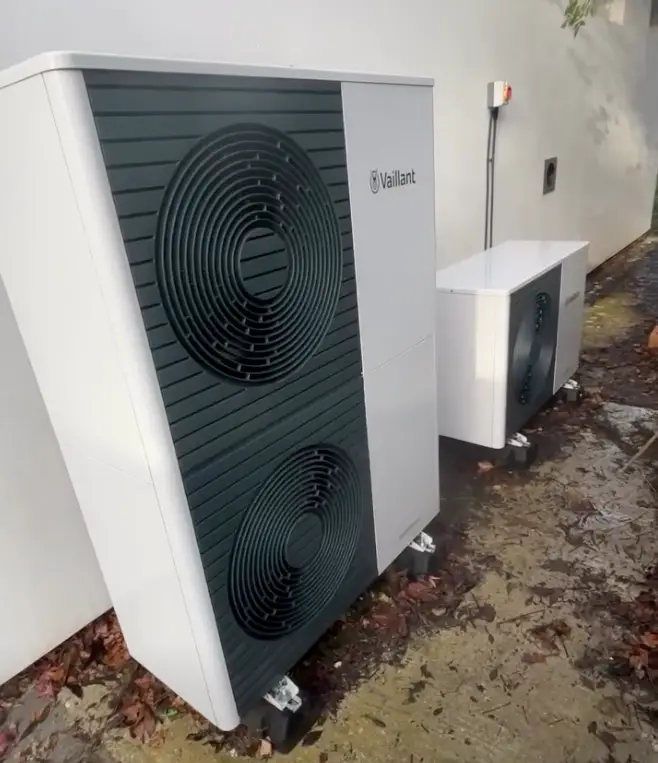
We specified a Vaillant Arotherm Plus 10kW heat pump, which is a very efficient unit due to its large evaporator coil. We could have chosen a 7Kw model, but the 10kw was the more efficient model for this customer.
The customer is a data nerd and a clever-clogs who is confident reading data, so I chose Open Energy Monitor heat pump monitoring for performance and efficiency visibility.
The heat pump came with a Vaillant SensoComfort thermostat for hot water and weather compensated heating control, and a Vaillant SensoNet to allow access to the system over the internet via the Vaillant app.
Ed also has Home Assistant, which he has managed to link to the Vaillant API for automated adjustments.
Cylinder, controls and secondary return
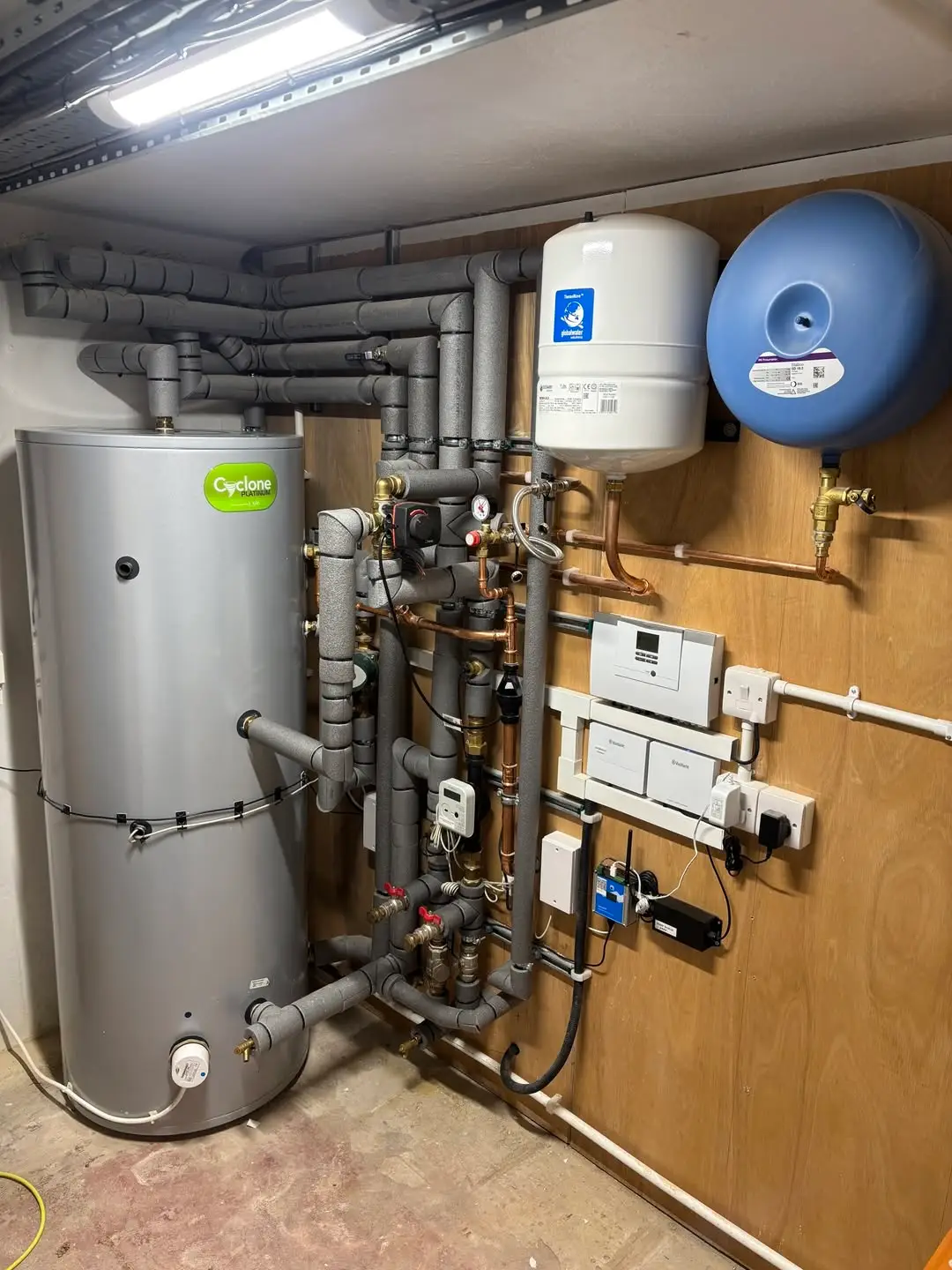
The DHW cylinder chosen was a Joule Cyclone Plus 250L combined with a DAB bronze circulator.
Joule is an extremely good manufacturer and based in Ireland, which is reasonably local. DAB are Italian, so this is at least on the same continent, but fundamentally, it’s good equipment.
This was paired with a Drayton pipe stat and lots of pipework insulation to keep the energy efficiency of the secondary return circuit as high as possible.
The diverter valve is made by Sweden’s best, ESBE. The VRG range provides high quality motoring and shut off with a high KVs value of 16, keeping the system resistance to a minimum and maximising circulation.
Pipework, radiators and UFH
I specified MLCP pipework throughout, with each floor piped independently back to the plant room in 20 and 25mm circuits, to maximise circulation and ease balancing.
All visible pipework was copper end feed, except for the plant room, which was press-fit and fully insulated in Climaflex. This is because, in a plant room, we always use rigid copper. However, MLCP is flexible and comes in long lengths, which makes it more useful for the rest of the system.
Emitter circuits were Purmo Compact radiators on the top floor and basement. Purmo is a UK manufacturer, which helped with maximum sustainability and quality.
UK company Multipipe were used for the UFH, with their pipe positioning panels allowing custom spacing and low resistance 16mm pipe. This made a low profile screed possible and cost effective.
A Monarch Midi water softener was also fitted for scale protection.
The budget for the renovation was 34k, part funded by the BUS grant, which we organised for the customer in partnership with Heat Geek.
What made this project different?
The build of the property was extremely unique. We were essentially turning a cold, brutalist concrete structure into a place of comfort.
There was a mix of exterior above ground walls and floors, exterior below ground walls and floors, intermediate floors, various insulation thicknesses added to the existing structure, different floor coverings, different room temperatures and different emitters.
It would have been easy to take a standard approach of installing a single output system throughout, then regulating room temperatures with stats and TRVs.
This would have strangled the heat pump flow rate, increased cycling and lowered efficiency. It would also have required a buffer and pumps installing, possibly mixers too, adding cost and reducing appliance performance.
This project pushed me to calculate a huge amount of variables if I was to deliver the desired temperatures throughout without detriment to the heat pump.
I was proud to be able to deliver this system open loop with no buffer.
Simplicity is not easy.
System performance
The system has been running since Summer 2025 and is performing excellently.
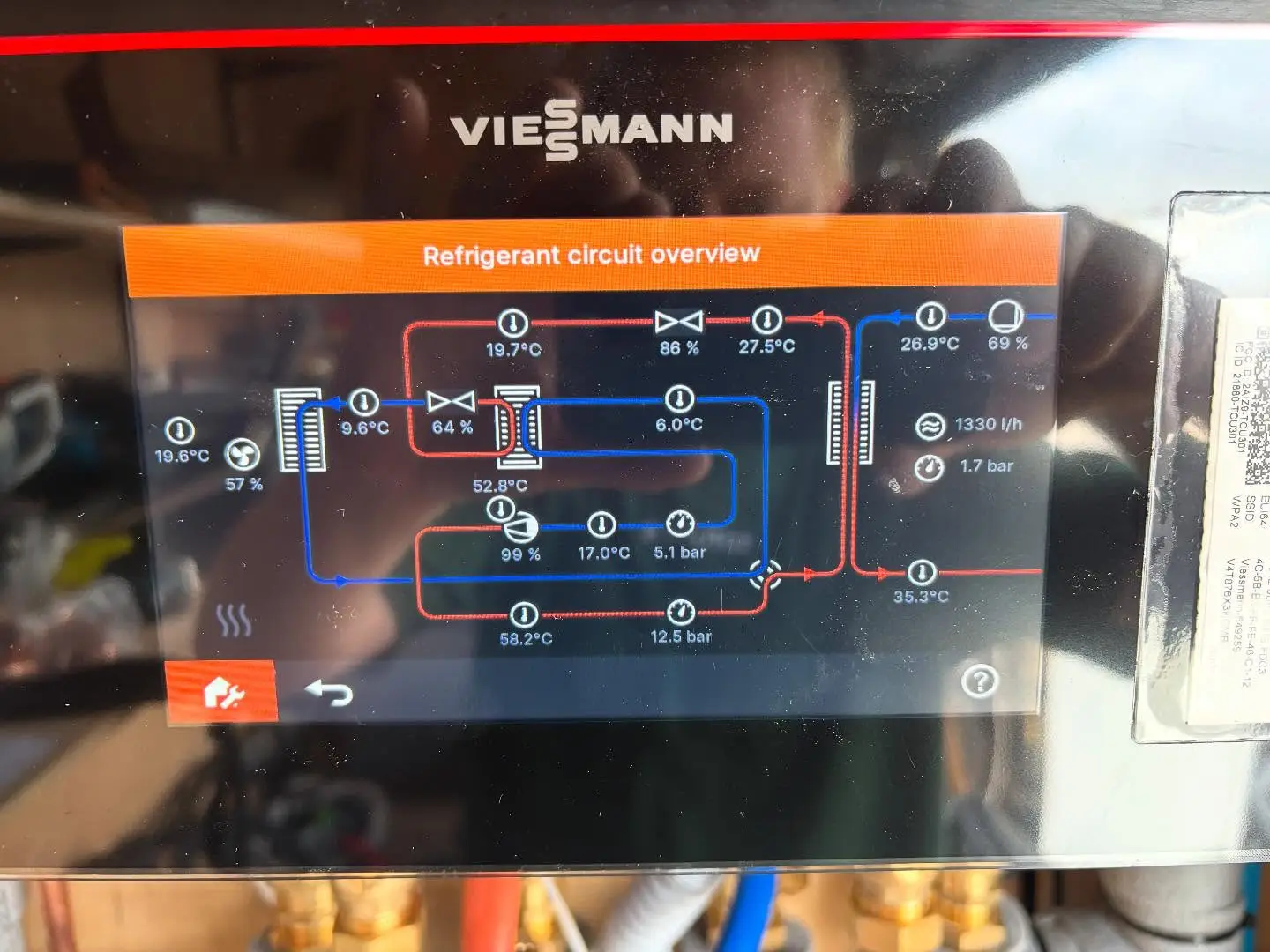
Open Energy Monitor was connected in December, and the average efficiency of the 3-month winter period is 468%, which is outstanding.
Customer testimonial
“I have long been interested in heat pumps and other renewable technologies. So, when I purchased a 1920s house in need of renovation, I had a chance to convert to an all-electric house with a heat pump. I understood how they worked, what a proper heat loss calculation looked like and what the important considerations were. So, when I say this installer impressed me, I mean it.
Every question I asked was answered with consideration. The system was designed properly for my home. The installation was clean, well thought through, and clearly done by a team who cared about the quality of their work.
The results back that up. My system is running at a SCOP of over 5, which is genuinely exceptional and only achievable when the design and installation are done correctly from the start.
I went in with high expectations and they were met. I’d recommend this installer without any hesitation and I’m happy to support their nomination for the Heating Installer Awards 2026.”
Going the extra mile with design
I overcame the challenges of different floor coverings and room temperatures by specifying four different pipe spacings from 100mm to 300mm.
With some balancing on the manifold, the ground floor is exactly where it needs to be, and Ed is a happy customer.
It is truly vindicating to see that going the extra mile with the heat loss calculation and emitter design pays dividends in the outcome.
What I learned
I learned a great deal on this project.
One thing was that you need to allow for a lot more core bits when drilling dozens of holes through concrete structures.
On a more serious note, I learned that there are shortcomings in heat loss methodology.
The basement level radiators have turned out to be oversized and required a lot of balancing down to achieve target room temperatures. This is due to the following calculation challenges.
When dealing with walls underground, we should be using ground reference temperature as the other side temperature. Software often doesn’t allow this.
My workaround for this was party wall ID, which sets the other side to 10C, which is nearly correct. However, the impact of U Values is important here.
A solid wall U Value may be 2.24 W/m2/K, whereas a solid floor is 1.15 or, if using BRE method, external perimeter related.
I suspect that I assigned an incorrectly high U Value to the solid concrete walls in the basement due to them being submerged underground.
As installers, we need educating on these edge cases. I would like to educate myself further on these matters, as the foundation of a successful installation is an accurate heat loss calculation.
This needs to be theoretical as well, because you cannot do an on-site test of a proposed renovation.
Heating design is both art and science
Another factor that came to light is that UFH in solid intermediate floors radiates downwards.
This was quite a revelation.
A major reason the basement is over-specced is that the ceiling is warm down there due to the in-screed UFH in the concrete intermediate floor above. No software, to my knowledge, accounts for this.
This illustrates how hard-won experience is, and that heating design is as much an art as it is a science.
The customer also set up Home Assistant to increase the curve of the heat pump weather compensation when the wind speed is above a given value, to resolve issues with the exposed location and air infiltration.
Amazing. We learn from customers too.
You can also read more Option Energy customer reviews from homeowners across Sussex.
Planning a heat pump installation in Sussex?
If you are renovating your home, replacing an old heating system, or thinking about moving away from gas or oil, Option Energy Solutions can help you understand whether a heat pump is right for your property.
We design heat pump systems properly, looking at heat loss, pipework, radiators, underfloor heating, controls, hot water and long-term running performance.
Get in touch with Option Energy